Future of work mindsets: comparing full-timers, side-giggers and alternative workers
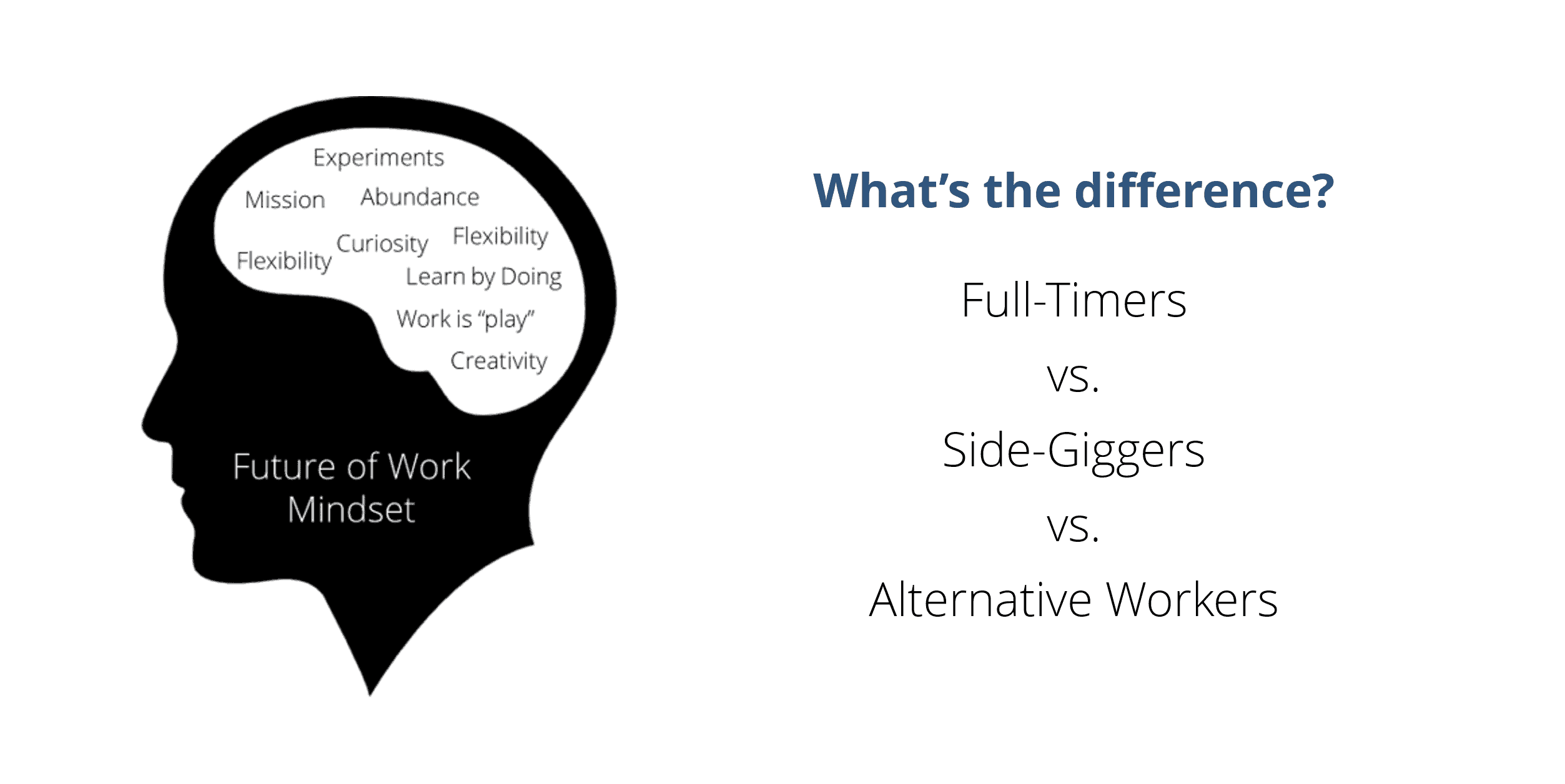
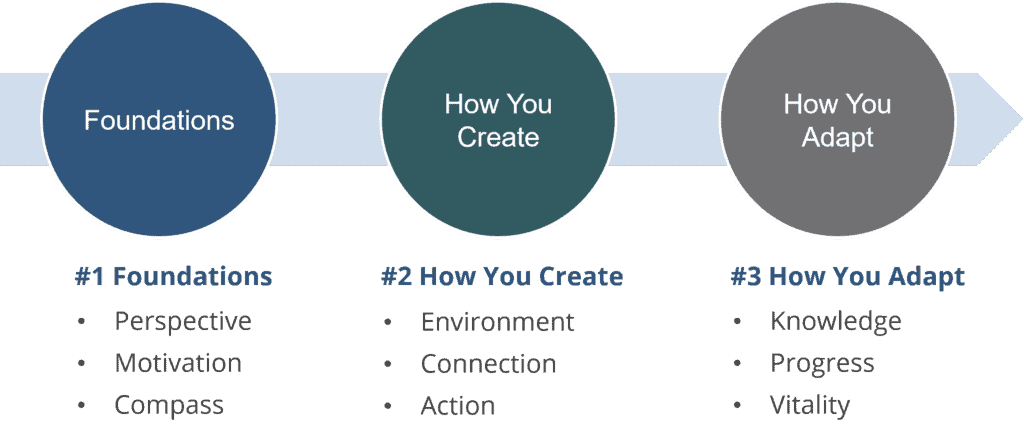
In March, I launched a 27-question assessment that asked people various questions across three main categories:
Respondents were given 27 statements (full report here) and noted how strongly they agreed on a scale from 1 to 5 with 1 being completely disagree to 5 being completely agree. With almost 100 responses, the data has been somewhat surprising and also has confirmed some other hypothesis I have had about the shift towards the future of work.
Alternative workers finding more satisfaction in work and life
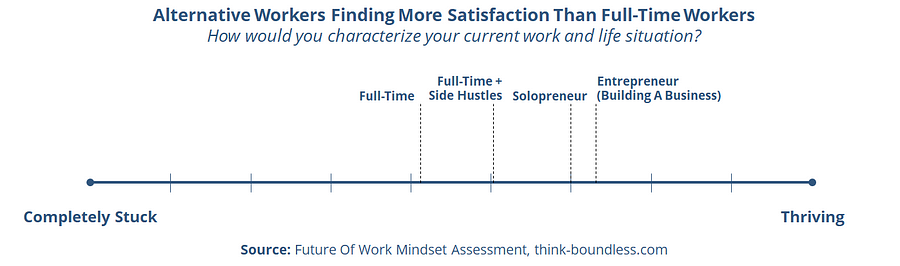
Alternative Workers Finding More Satisfaction Than Full-Time Workers
How would you characterize your current work and life situation?
Side Hustles
Source: Future Of Work Mindset Assessment
I asked people to categorize themselves in four categories and found that “alternative workers” — solopreneurs and entrepreneurs — are finding the most satisfaction in life and work. Full-time workers averaged a score slightly over 5 out of 10 in this question.
Alternative workers place more importance on questioning the norm and autonomy
Both full-time workers and alternative workers consider themselves open to new ideas and experiences and also think about their career in terms of a set of skills and projects, rather than specific roles or a path.
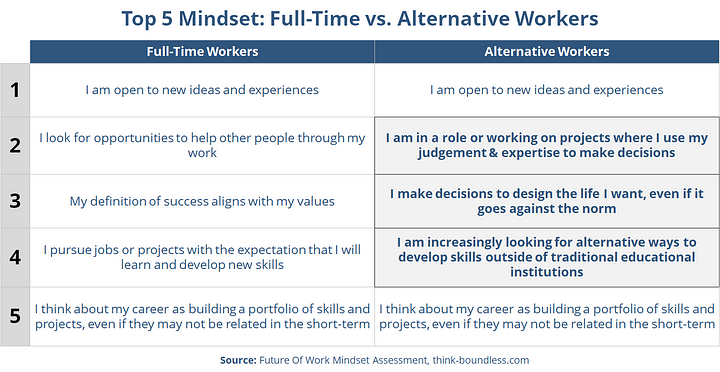
However, three things stood out relative to full-time workers. Alternative workers:
- Have more autonomy
- Are actively designing the life they want
- Are looking to build skills from areas outside traditional academia
What makes alternative workers different than full-time workers?
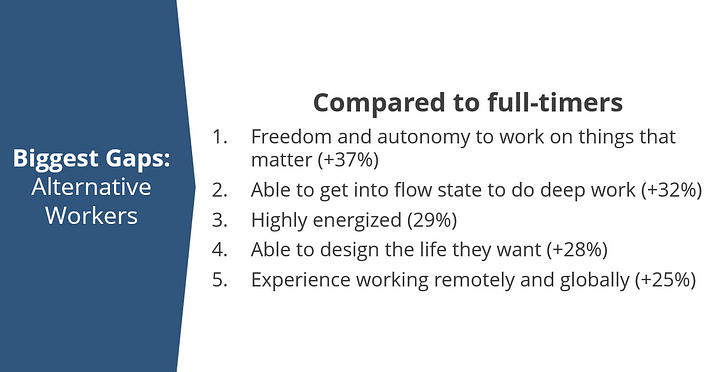
When comparing the answers with the gaps between full-time workers and alternative workers, the biggest gaps were from the following five questions:
“I have the freedom and autonomy to work on things that matter to me”
“I get into a flow state to do deep, meaningful work at least once per week”
“I am highly energized through my work and how I spend my time”
“I make decisions to design the life I want, even if it goes against the norm”
“I am experienced working in global, remote teams”
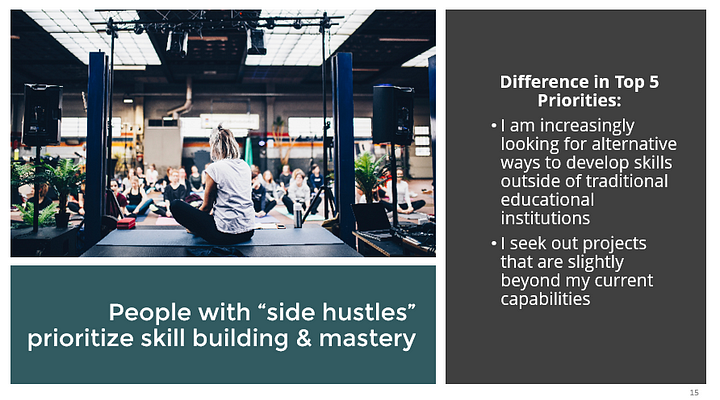
Full-time workers that have side gigs tend to prioritize skill building and mastery
One surprising finding was the differing priorities of full-time workers and full-time workers with side gigs. Within the top five mindsets, full-time workers with side gigs focus deeply on skill building, looking for ways to improve and evolve and looking for projects that will push them beyond their current capabilities.
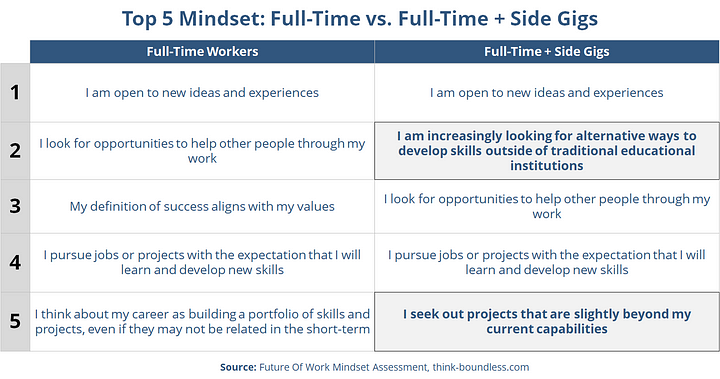
Pushing yourself beyond your current capabilities is another way of defining “mastery” and element that has been proved to drive human motivation. So it is no surprise that full-time workers with side gigs are finding more satisfaction in both their life and work.
What are the biggest differences between full-time workers with side gigs and full-time workers?
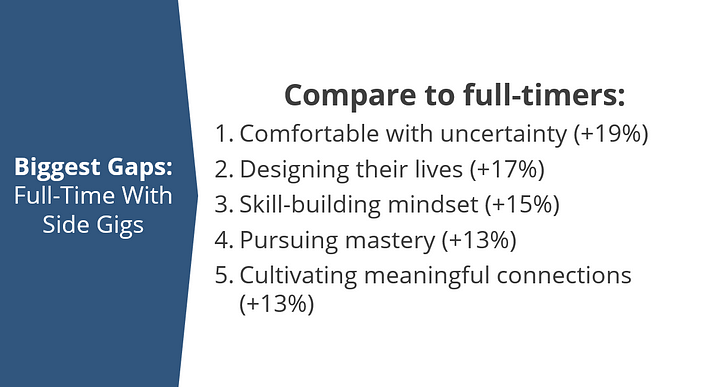
Compared to their gig-less peers, full-time workers with a side gig are more active in creating their own future, building skills and cultivating meaningful connections. In addition, the biggest difference was the answer to the question:
“I am okay not knowing what work I will be doing in two years”
Side-giggers rated the question very close to alternative workers, acknowledging that there is not a well-known or established path they may be pursuing. In addition, the biggest difference between their gig-less colleagues:
- Okay with uncertainty: “I make decisions to design the life I want, even if it goes against the norm” (+17%)
- Focused on skill-building: “I am increasingly looking for alternative ways to develop skills outside of traditional educational institutions” (+15%)
- Mastery-minded: “I seek out projects that are slightly beyond my current capabilities” (+13%)
- Building relationships: “I cultivate deep, meaningful connections where we help each other grow” (+13%)
Bottom 5 Mindsets: The Challenges In The Future Of Work
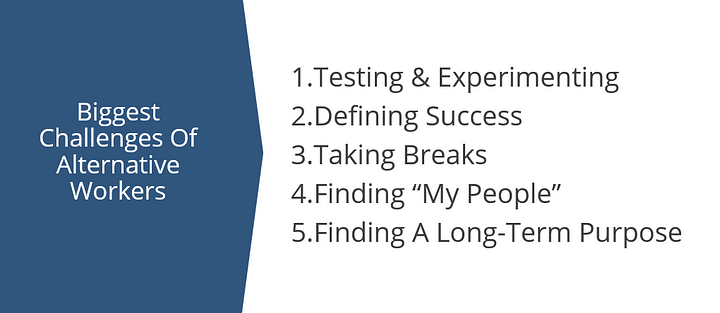
The lowest scores among alternative workers were focused on action, experimentation and focus, finding community and purpose — challenges for most people. The nature of being “on your own” often forces attention on these deeper and more fundamental questions.
Data from the survey shows that people are struggling with these five areas:
- Testing Ideas: I test ideas or take an 80/20 approach to projects to quickly assess whether or not to invest more time in something
- Defining Success: I have a personal definition of success that I regularly reflect on
- Taking Breaks: I know how to balance deep work and breaks (e.g. health, fun, mindfulness)
- Community: I feel part of in-person or virtual communities that have shared values
- Purpose: I have a long-term mission or sense of purpose that I am committed to
Interested in taking the survey?
Download the full report (PDF)
Why it matters: My essay on why the “future of work mindset” matters
Join 25,000+ curious readers
Reflections on life, work, and what really matters